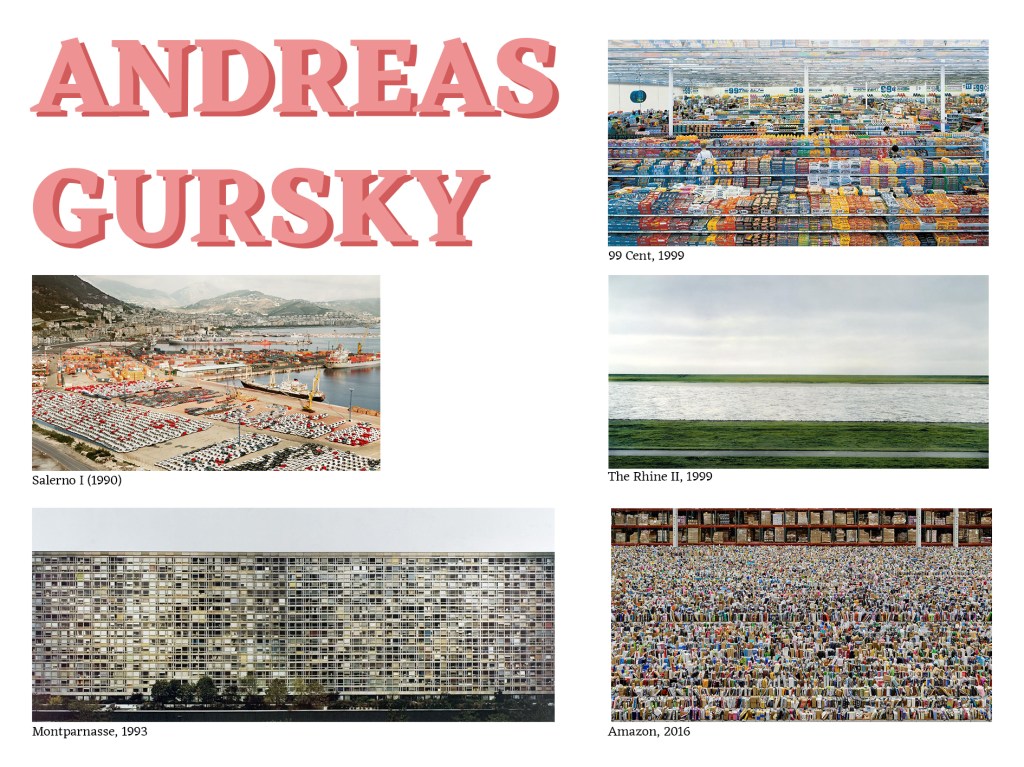
German photographer Andreas Gursky is best known for his large-format landscape and architecture photographs. Gursky uses a high point of view and finds places to photograph with mass consumption, as you see in the images above. For example, the photograph ‘Amazon, 2016’ uses mass consumption, where Gursky digitally stitches and layered together photographs to create one big image. The attention to detail, even to the smallest items, makes a big difference. It makes the viewer’s eye pulled in to look at everything, and this makes it slightly overwhelming.
In another photograph of Gursky, ‘Montparnasse, 1993’, Gursky took the 750 flats from a hotel lobby from the other side of the street, in which he used the same technique of stitching together photographs to create one big one. This image produces so many shapes, almost beehive-like, but when you look closer and see the individual cluttered interesting lives happening, it produces a “beautiful confection” (The Art Channel, 2018). The scale of architecture, landscape, and an urban scene in the modern world, draws your eyes to the individual windows, and you start to see how people fill up these spaces. This image is including an enormous superstructure, which fills up the entire space and horizon of the image. From the viewpoint Gursky took the photo, he plays with perspective, which helps emphasis the image.
The photo ’99 Cent, 1999′, is an “inventory of our consumerism” (The Art Channel, 2018). As Gursky increased the colours of the image, it makes the image more bold and powerful. It reminds me of looking at the candy shop pick ‘n’ mix wall when I was a child. It’s an impactful image because the eye doesn’t know where to look, because of all the bold colours, shapes and rows. To me, it is estranging, but so nostalgic at the same time.
What is interesting is that Andreas Gursky says
“I’m not interested in individual lives. I’m interested in the way we live; we work, we consume, the way we move through spaces” (Andreas Gursky).
You see that within his work, it’s simplistic but busy at the same time. I would want to try to take photos from a high viewpoint, to try to capture different peoples living environment.
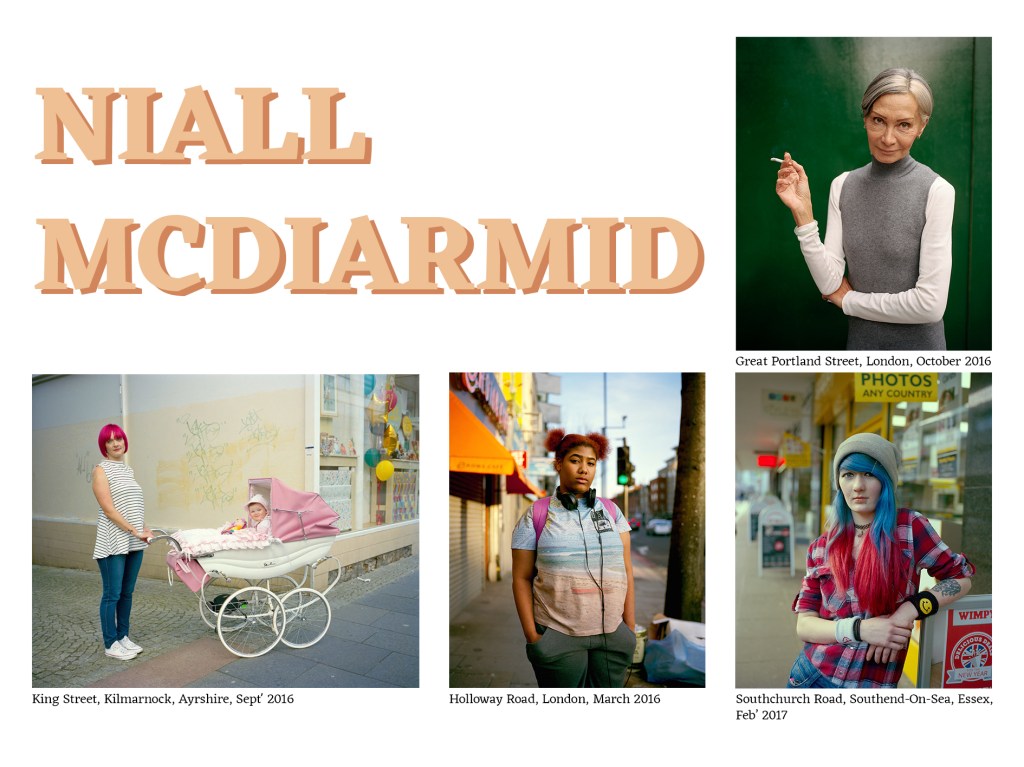
Niall McDiarmid is a Scottish photographer, where he documents “the people and landscape of Great Britain” (En.wikipedia.org, n.d.). In his work the arrangement of colours with the people are fascinating, even sometimes it happens by chance. For example, in McDiarmid book ‘Crossing Paths (2013)’, the image above ‘Southchurch Road, Southend-On-Sea, Essex, Feb’ 2017′. In an interview with McDiarmid, he mentions that when he took this image, it was by chance, McDiarmid asks the girl to stand there, with her parents behind him, McDiarmid said he couldn’t miss this opportunity with a girl who looks cool like this. What’s quite ironic is that the word ‘photos’ at the top, but also the word ‘wimp’. Implying that she is not a wimp, she is fierce from the way she looks. In this image, the colour palette works well, from her outfit and hair to match the sign. And the yellow smiling face image matching the rest of the building. In most of his photos, the subject is always looking down the barrel of the camera. With their personality, stare and look. He is always looking for a pop of colour, whether if it’s in the foreground or the background. What’s interesting is that none of the subjects seems to feel awkward; they seem comfortable. Because McDiarmid never wants the subjects to pose, he wants them to act themselves. Even if that’s through a blank face, not smiling or frowning, their personality comes through. Their personality comes across in his photos, again in the photo above ‘Holloway Road, London, March 2016’, even though she is not smiling and has a blank face, you can see and feel the attitude come through. From the outfit, the way she is standing and her background.
McDiarmid style and eye for spotting the people and placing them in their environment, is inspiring, the photos are clean looking, in where he must have used a lower aperture, to separate the subject from the background. However, I like it how he hasn’t put the aperture too low, where you can still see the background and work out where they are. It’s having the confidence to ask people to photograph them, and not taking too much of their time up.
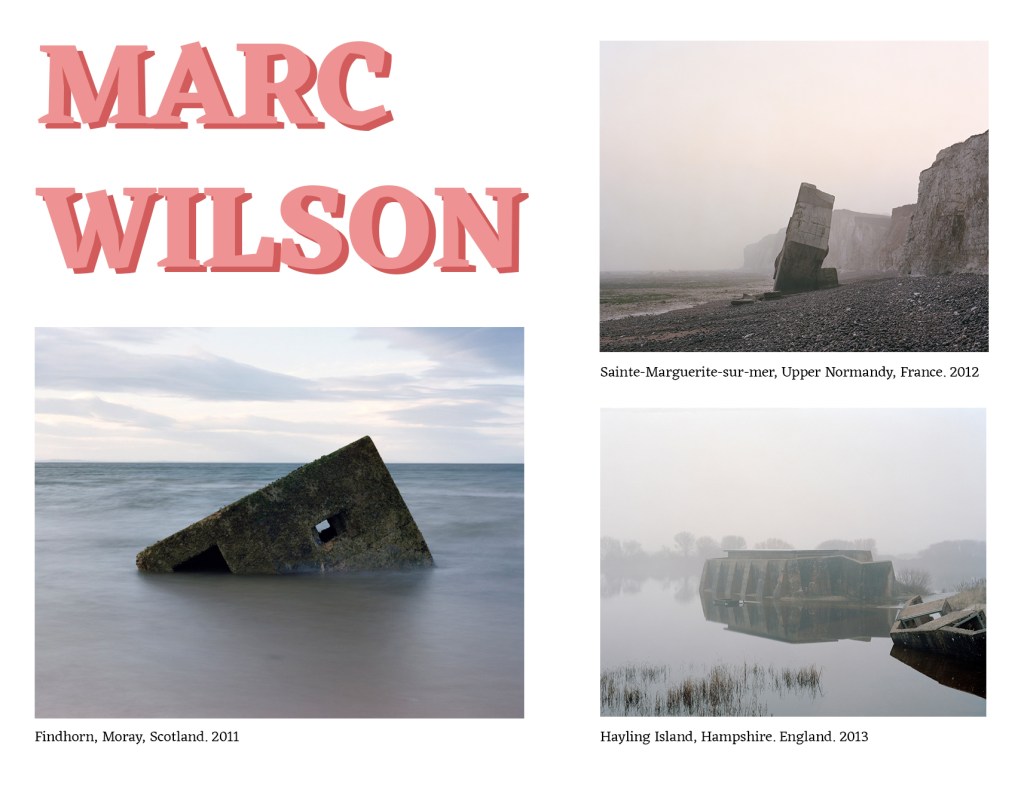
English photographer Marc Wilson photographs and “documents the memories, histories and stories that are set in the landscapes that surround us.” (Marc Wilson Photography, n.d.). When Wilson works on his documentary projects, he spends a long time creating them, the images above are from a book called ‘The Last Stand’, which Wilson completed in 2014.
“Marc tells stories through his photography, focusing at times on the landscape itself, and the objects found on and within it, and sometimes combining landscape, documentary, portrait and still life, to portray the mass sprawling web of the histories and stories he is retelling.” (Marc Wilson Photography, n.d.).
In the images above, I mention they are from ‘The Last Stand’, they all have a military aspect to it. As time passes, these military structures become more and more critical. They were constructed over 50 years ago and for a different purpose. Because as time passes, the memories of structure/history disappear, and the lives that were involved all start to pass away.
“It works like this that becomes more important each day.” (Marc Wilson).
To shoot these images, Wilson used an old large-format film camera, and when he takes the photos, he waits for the perfect condition. This condition is a soft, subdued light, not a sunrise or sunset because he doesn’t want to add any “extra drama” (Marc Wilson) to the image. Because the structure (subject) itself doesn’t need more drama to it. In most of his pictures, you can see that he also shoots in foggy, sea mist conditions or a “very flat soft grey light, early in the morning so there are no people about” (Royal Armouries, 2013).
But what’s interesting is that these man-made defences sit quietly in the environment. Some are in better condition than others and slowing decaying away from their surroundings. But all structures have become factors of changing the landscape around them. Wilson has produced images that make the structures look calm and beautiful, even though thats not what they were intended to be used for, for war. Wilson wants these images to become a permanent photographic record of the past. To each structure has a history of stories to tell, “one of unfulfilled defiance or one of tragedy” (Shetland Arts, 2016).
Findhorn, Moray, Scotland, 2011, (found in the image above), is really simplistic and a beautiful picture. My first thoughts are that it is really calming, even though that structure was not used for that (juxtaposition). It is calming because Wilson has used a long exposure, so the sea/waves have become milky and soft. Making the texture of the war structure stand out even more. Both a rough, jagged object against a delicate, gentle sea wave really works. Even the shapes produced, for example, the horizontal line in the background that breaks the sky from the sea, and the triangle shape created from the war structure. However, even though his images are simplistic, I think going simple is sometimes more beautiful and picturesque.
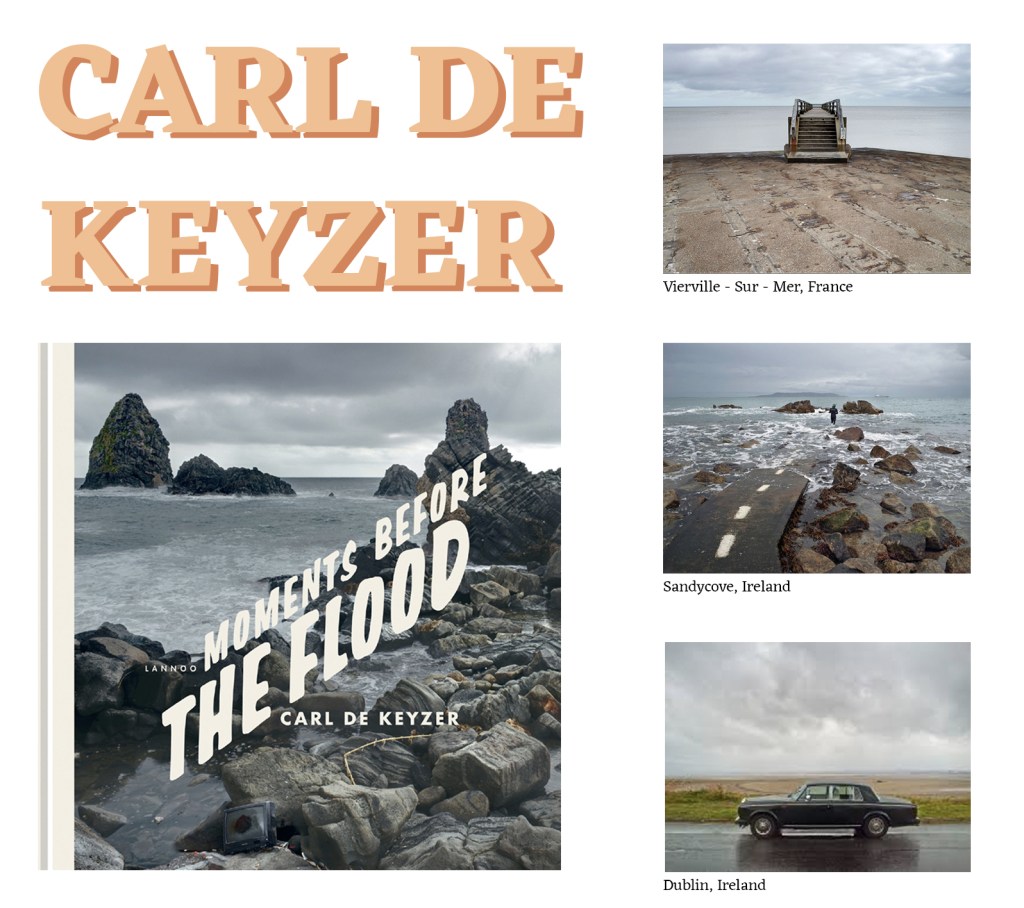
Carl De Keyzer is a Belgian photographer, and his project ‘Moments Before The Flood’, (shown in the image above), shows his journey along the European coastline. De Keyzer had travelled more than 82,000 miles and visited more than 5,000 locations, for this project, resulting in a big success.
The series is about how he “examines how Europe copes with hard to predict threats – that is rising the sea level” (fotofestiwal, 2015). This is due to climate change. But De Keyzer also researches different prevention strategy of the coastline over the years. And how Europe will cope with the potential floods in the future and now.
As you can tell for De Keyzer books, his projects are not composed of single images, but he prefers a collection/series. This is what I’m working towards, creating a set of 4 images. On the other hand, they all connect/links together because of the coastal/sea theme. Which tells a story and makes it interesting at the same time, what is something I want to do within my work.
Carl De Keyzer work does remind me of Marc Wilson in some ways. They both involve or have the sea/coast in their images. For example the picture above ‘Vierville – Sur – Mer, France’. But the big difference between the two is that Carl De Keyzer images have a sign of life. Not all of his image has people in them, but people possessions. For example, the picture above called ‘Dublin, Ireland’, even though it is simple, it has a sense of life and journey.
BIBLIOGRAPHY
En.wikipedia.org. (n.d.). Niall McDiarmid. [online] Available at: https://en.wikipedia.org/wiki/Niall_McDiarmid [Accessed 24 Oct. 2019].
Fotofestiwal. (2015). Carl De Keyzer, “Moments Before the Flood” and other journeys. [online] Available at: http://www.fotofestiwal.com/2015/en/events/hit-the-road-photographers-travel/carl-de-keyzer-moments-before-the-flood-and-other-journeys/ [Accessed 24 Oct. 2019].
Johnson, W. (2015). A Photographer Anticipates the Moments Before the Flood. [online] Nationalgeographic.com. Available at: https://www.nationalgeographic.com/photography/proof/2015/12/10/carl-de-keyzer-moments-before-the-flood/ [Accessed 24 Oct. 2019].
Marc Wilson Photography. (n.d.). Marc Wilson Photography Bio. [online] Available at: https://www.marcwilson.co.uk/bio [Accessed 24 Oct. 2019].
Royal Armouries (2013). The Last Stand – Marc Wilson. Available at: https://www.youtube.com/watch?v=arTdlo_yYsM [Accessed 24 Oct. 2019].
Shetland Arts (2016). Mark Wilson: The Last Stand. Available at: https://www.youtube.com/watch?v=wu-qGkSvB2Q [Accessed 24 Oct. 2019].
The Art Channel (2018). Andreas Gursky at the Hayward Gallery. Available at: https://www.youtube.com/watch?v=W57umhTmuOw [Accessed 24 Oct. 2019].
 SARAHLOCKYERUCA