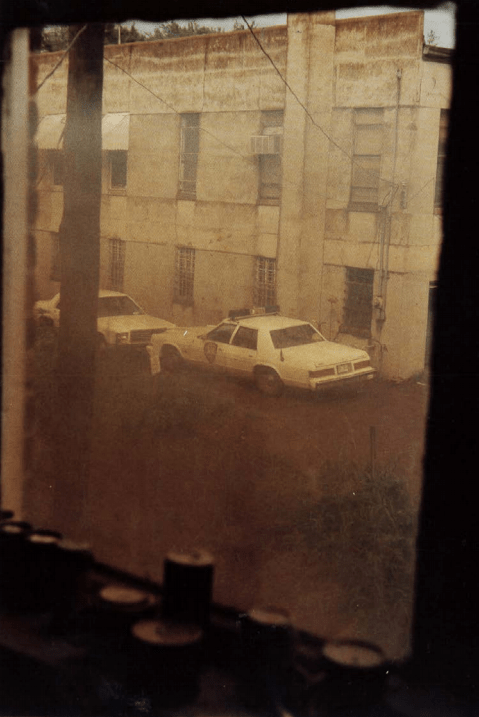
In this image, I get a sense of danger and safety at the same time. As the viewer, I feel danger from the police car outside, the surroundings and atmosphere don’t seem the friendliest. We know this from the bordered up and dirty windows to the lack of life and low living conditions. It makes you question the emptiness of the area.
However, as the image was taken from the inside of the building, looking out at the danger. It makes me feel safer, that I’m inside away from the police and outside. William Eggleston is making us feel that we are at a safe distance waiting/watching for something to happen at any time.
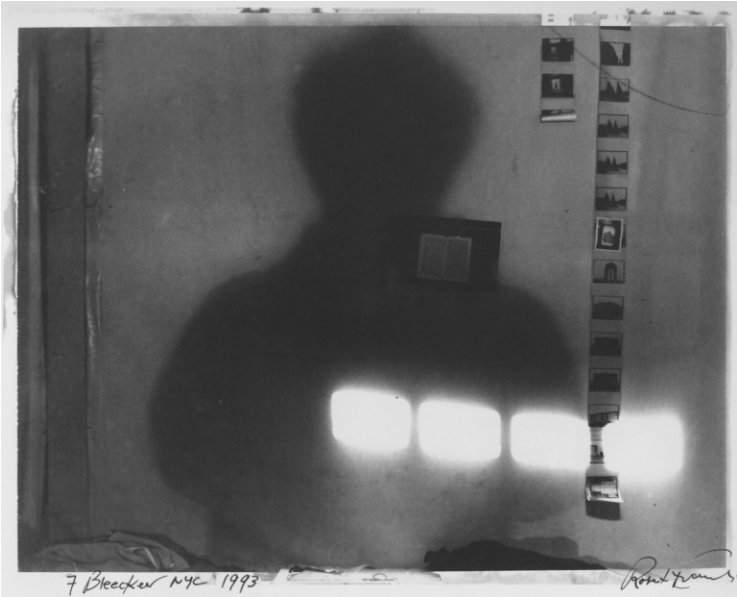
ROBERT FRANK, FROM STORYLINES, 2005
MYSTERY, BLACK&WHITE, SHADOW, FILM
Robert Frank has brought a different viewpoint, by bringing the outside in, with the film negatives. The shadow of the person creates a sense of mystery, making the viewer’s eye look closer at the individual film images. To work out who this person is? What’s there lifestyle? Why are they doing this?
The contrast between the shadows and bright light enhances the shapes created, to draw the viewer eye to the film. Especially as the subject is in an empty room, it makes these shadows, bright lights and film stand out even more.
It is an exciting way of bringing the outside in, by taking a photograph of photographs and keeping the atmosphere mysterious.
BOUNDARIES BETWEEN THE INSIDE & OUTSIDE
The boundaries between the inside and the outside can produce different views within a photograph. A line of division between the inside and outside, or an intermix of each other. By intermixing makes the image blend more, rather than feeling like a wall between the boundaries. Below I have two images exploring these ideas, I’ve mentioned above.
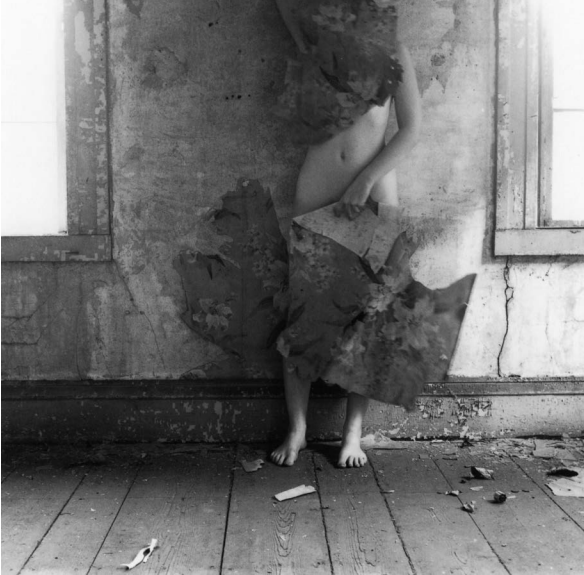
FRANCESCA WOODMAN, THE OPTICAL UNCONSCIOUS, 1993
Francesca Woodman has used the person body from an outside environment to camouflage themselves to the inside surrounding. They’re making themselves apart of the inside. Almost like they have taken over the inside now, that they own it.
The place isn’t homely, and it makes the viewer feel alienated, as the inside doesn’t have any carpet, furniture, or wallpaper. The person is bringing the outside material in (wallpaper) and blending in with the inside. This is a different way of bringing together the inside, and outside, it also feels quite mysterious, the way Woodman has framed the image. Woodman has chosen not to frame the face, which makes the body blend into the inside better. The way Woodman has framed the windows is interesting. It draws you away from thinking about the outside and directs your viewpoint straight to the body.
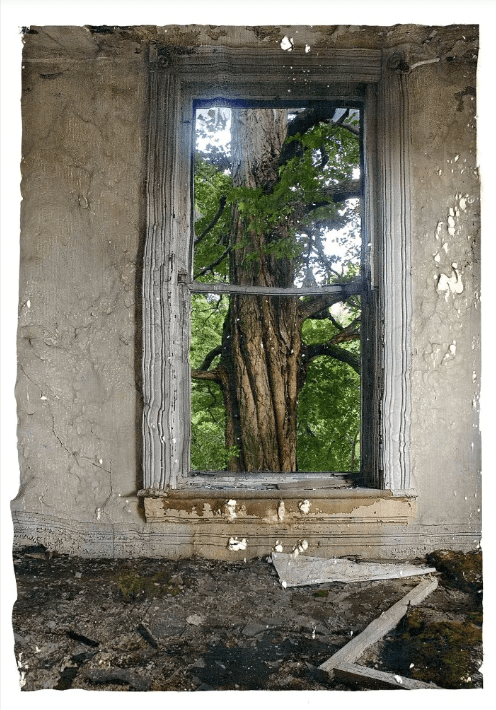
KEV FILMORE, INSIDE OUTSIDE, 2011
Kev Filmore has framed the inside and outside together. This juxtaposition shows the dead, uninhabited, muted, rotted, ugly, dangerous inside and frames it with a beautiful, alive, colourful, fresh tree outside surrounding. Placing together two opposites works, this shows development over time, the inside has disintegrated, but on the outside is a flourishing, lively environment.
The way Filmore has framed the image, making the window central is smart because this leads the viewer eye towards the window. The colour palette also helps with this, as the inside is a muted colour and the outside is colourful.
The image is different from Woodman’s image above, rather than camouflaging or blending the inside and out, Filmore has used the window as a wall of division. Dividing itself from the ugly to beautiful, or the rotted to growing.
Street Photography – “Street photography, also sometimes called candid photography, is photography conducted for art or enquiry that features unmediated chance encounters and random incidents within public places.” (En.wikipedia.org, n.d.)
From researching, I have created the list above of keywords, that I think relates to the street.
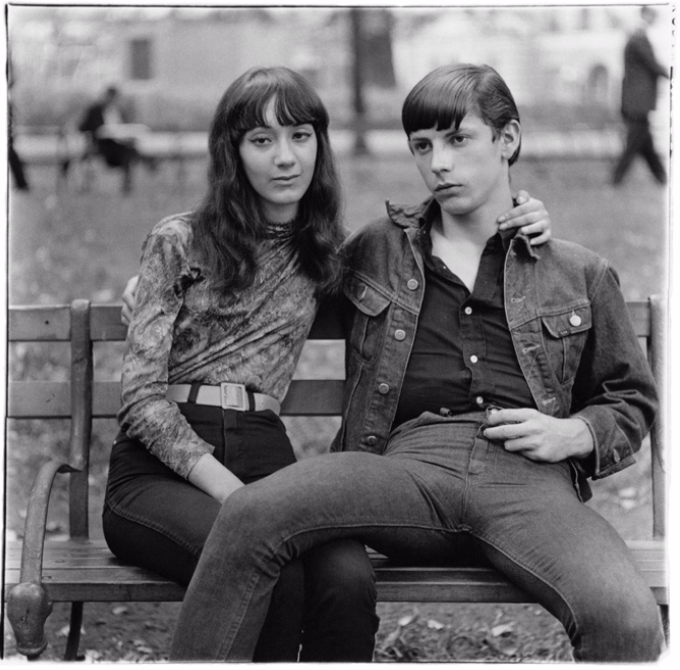
DIANE ARBUS
Young couple on a bench in Washington Square Park, N.Y.C., 1965
PROTECTIVE,PORTRAIT, DISTANCE
In this image, Arbus has taken a candid portrait image of a couple. This couple seems typical, but as you start to look closer, perhaps you start to see that the women isn’t happy or comfortable around the man. From the position of her hand and the distance of her pulling away from the man, she seems awkward. But on the other hand, the man is dominant as he has his leg on top of her, this could imply that he controls the relationship. As he also doesn’t make eye contact with the camera, he seems less approachable than the woman, and angrier. I like the use of selective focus on the couple, as it blurs the background it gives the people more movement, as they walk past them. Sometimes it good to show people like this, because the street is not always full up of happy people.
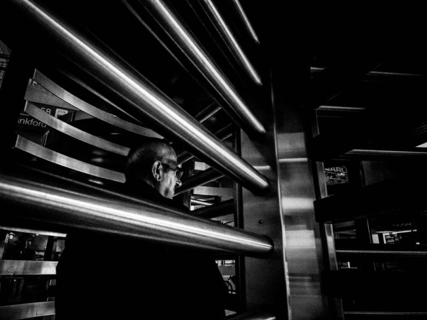
DON SPRINGER
Going to the train
TONAL CONTRAST, TRAP, PRISON, SINISTER
In the photo, the subject seems to be a trap. Like the man is trap inside a prison, it has a dark atmosphere about it. The tonal contrast contributes to this, making it look more sinister and dangerous. The low viewpoint and closeness of the surrounding make the viewer feel trap and claustrophobic as well.
It’s an uncomfortable feeling, even though most people use this every day of their way of commuting. When you imagine making your way to the train station you don’t imagine it to look like this. The fact that Springer hasn’t shown the face of the man makes the image more mysterious. Springer has also done a great job at framing because these gates move quickly round, and the station was probably busy, especially being in New York.
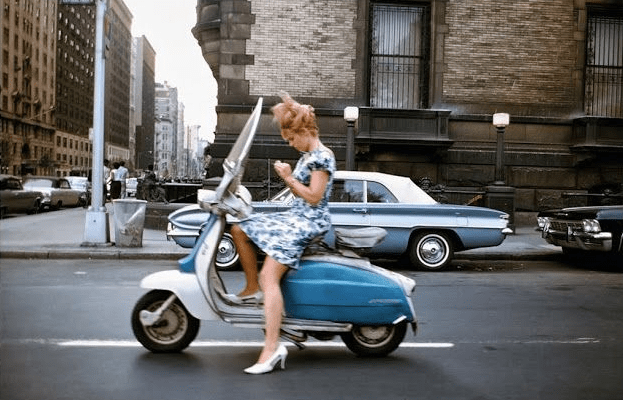
JOEL MEYEROWITZ
Girl on a Scooter, New York City, 1965
MOVEMENT, BLUE, CITY, SELF-CONSCIOUS, POSSIBLE DANGER
In the image, Joel Meyerowitz has taken an image of a woman on a scooter, amid New York City. What’s fascinating is that the woman is more worried over her looks than her safety. She is stopped in the middle of the road to check her nails. There may have been a red light in front of her, which could have been a possibility. But also by the way she dressed, she is wearing a dress in heels. Which implies that she is not worried about the danger of herself, because heels are not the safest shoes to drive in, also stopping in the middle of the road is dangerous as well.
The colours in the images are beautiful. Meyerowitz captured the woman in a blue dress on a blue scooter, and a blue car in the background. With the browns, greys colours of the roads and buildings surrounding her, this makes her stand out well. And direct the viewer’s eyes directly onto the woman.
Movement in this image is a crucial element, you can tell she is in a blur, I don’t know if that was intentional, but it works. The movement of the people in the background and other cars makes up the photograph. It tells a story about her and the city that surrounds her.
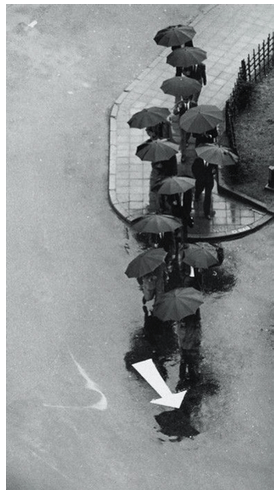
ANDRE KERTESZ
Rainy Day, Tokyo, 1968
FOLLOWERS, LEADING LINES, DIRECTION, BLACK&WHITE
The use of direction from the people and the arrow produces a leading line in this image. It’s like they are all followers. All the people under the umbrellas, look the same and are taking the same direction. As the image is in black & white, the arrow becomes a bright white, and your eye is drawn to this first, it is effective.
The weather condition can help make images more effective and certain elements stand out more. In this case, the rain brings out the shininess of the ground and the umbrellas. Especially as Kertesz has taken this image from a high viewpoint, makes it feel like they are taking a path, as the pavement is making a curve shape leading the people round to the arrow. From the height, it makes the people look ant-like, because of how small they are, they all look the same, and they are taking the same path as ants do. It also makes you think, do all of these people work together? Do they know each other? Is this their way of travelling? Where are they going?
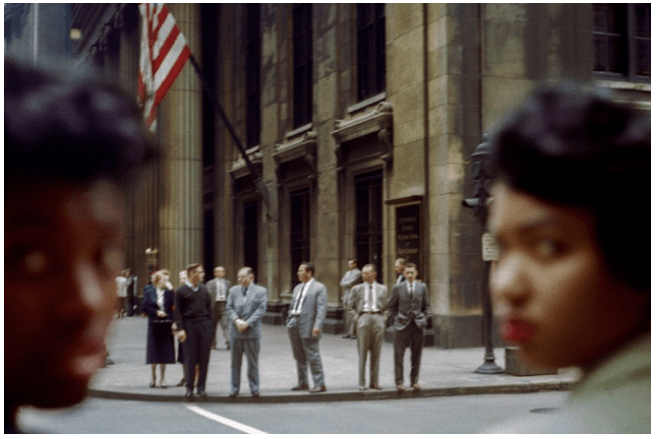
In this photograph, my initial reaction is the separation between colour. I don’t know if this was deliberate, or was a consequence, but it seems like separation of the people. The way how the only people looking back are the dark tone women is interesting. It could imply that the white businessmen and women won’t listen or look their way. As they are blurred, this could mean that back in that time, society pushes them to the back. This links as there is an American flag hanging, meaning that this building is where people perhaps have good, well-paid jobs. And the sense that the reason why the women are looking back is that they don’t have good jobs.
The way Maier has framed the women is also like a window. This window is what they see, and maybe who society (at that time) thinks was more important. There are mixed emotions in this image, and you can tell from their faces and body language. The darker tone women look unhappy and sad with a bit of attitude. However, the white men and women, look relaxed and happy. Maybe because they don’t have to worry about many things, whereas the other women do. This is why street photography is essential, because it can document and pick up moments and emotions about that part in time and where in the world.
DEFINING ‘THE STREET’
‘The street’ to me can mean many things — a way to lead you home or to meet new people. Compared to the landscape, the street is fast-moving, busy and tends to be a lot more happening. For example, vehicles, crossing a street, architecture, people, even to the displays of the shop windows. The street is a modern urban experience, where people put on their best clothes, but never even talk to each other, or let alone see that person ever again. So why do people do this? Street fashion is not a catwalk fashion style. The street is full of real people. However, the street is not just made up of people; it’s the architecture. The windows and doors make up the city, from the objects on display, to the idea of space between the window & display. Even advertisement such as people holding a newspaper can make up a street and bring it even more to life.
I think the street is about the moment. In a studio, you can reproduce an image asking the model to do the same pose again, but on the street, you can’t ask a car or person to go past you again, it’s in the moment and timing. Also, this can be down to the time and day. The streets can change character over time — for example, Saturday night vs Tuesday night, or night vs day. Parts of the world are culturally different, from London streets vs Tokyo streets.
But the street can also be used to document life and events. For example, protests, this could highlight a great sense of community and sub-culture. But also could document the ugly sides to the protests going on in the world. There are also two different sides to the protest that could have an interesting interaction. The sides are the protesters and the police. Most of the time, the police are there to keep things civil and safe, but there are some times where incidents happen, and these communities could turn into crime, which crime is another part of the street. Peoples lifestyles and choices could influence this. Capturing these moments requires patience and time. Waiting around for the perfect moment can make the street characteristics come to life, and show the true essence of a particular area.
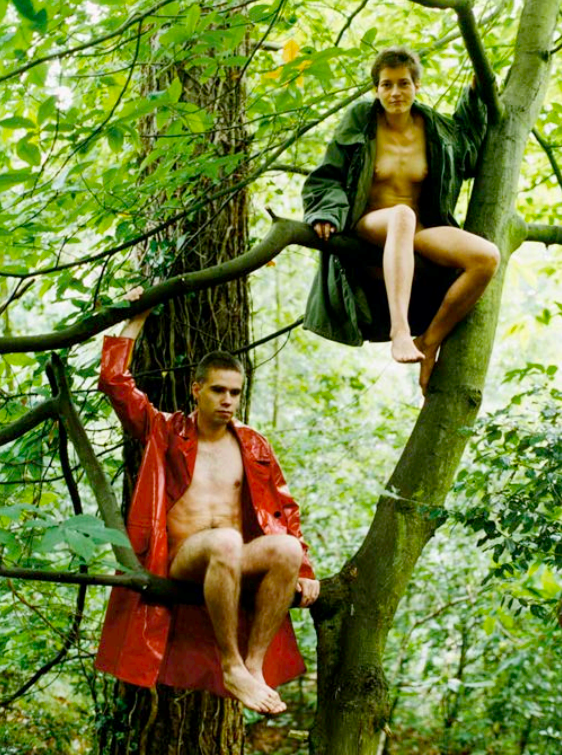
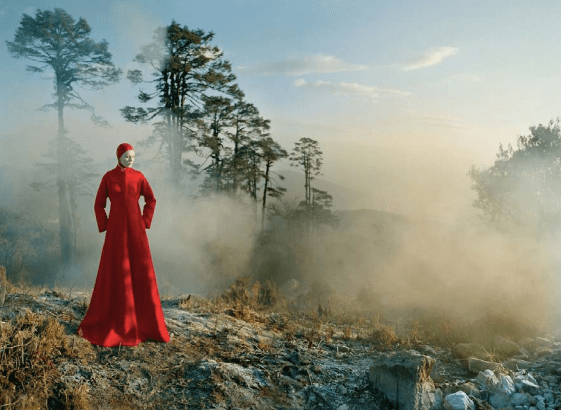
Wolfgang Tillmans – Lutz and Alex sitting in the trees 1992
FREE, NATURE, FASHION
Tim Walker Vogue Spring 2015
COLOUR, SUBLIME, NEGATIVE SPACE, PICTURESQUE
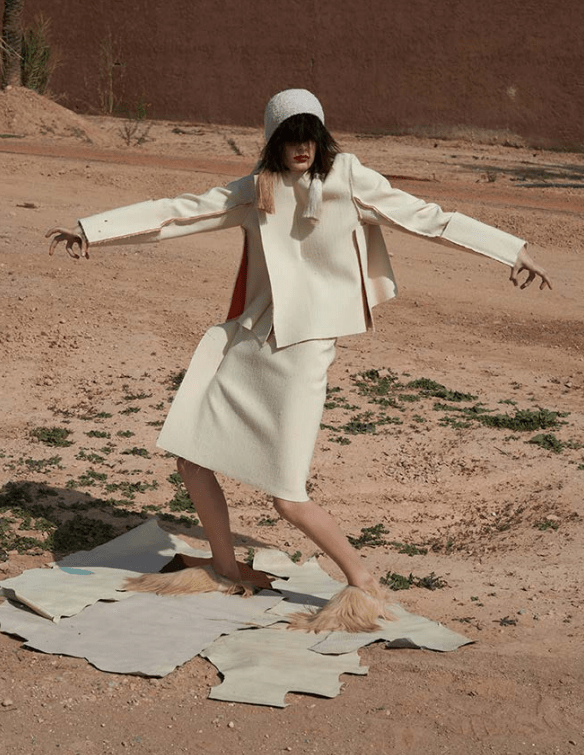
Mel Bles Pop 2014
OUTSIDE, FASHION, WACKY
Juergen Teller Kanye, Juergen & Kim 2015
JUXTAPOSITION, SUBLIME, CELEBRITY, NATURAL
COMPARING
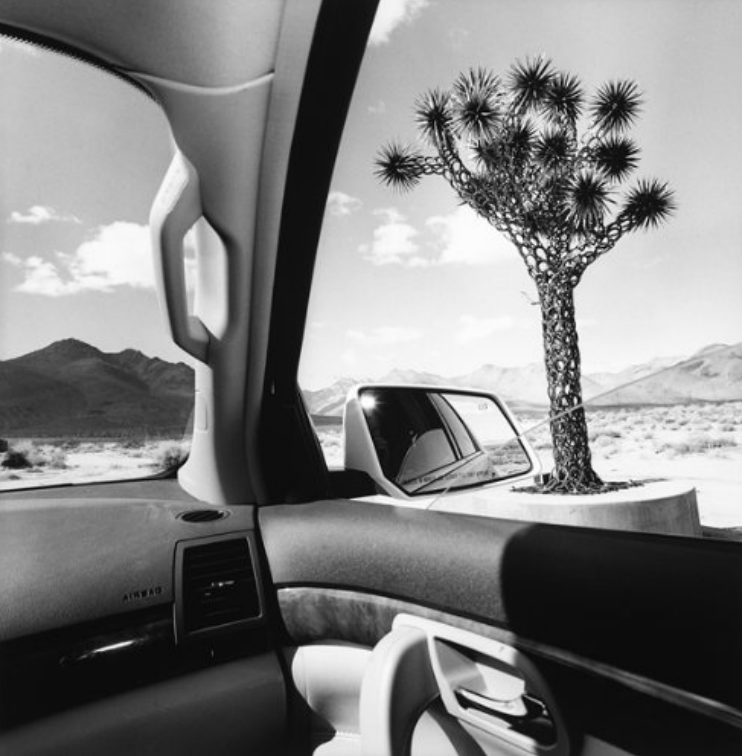
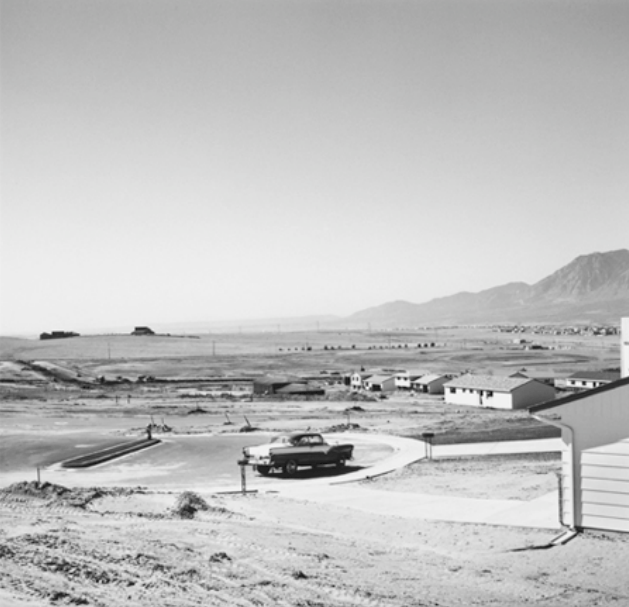
Lee Friedlander, from America by Car 2007 & Robert Adams Colorado Springs, Colorado 1968
In both images, you can see they’re related, for they both have a car in the image, but the photographers have created a different feeling across from my perspective.
The left image by Lee Friedlander has an interesting viewpoint. Where it makes the viewer feel inside, but outside at the same time, giving the image more depth and structure. The car door is closed; it feels like a wall of division between the inside & outside landscape. However, the image on the right has a more distant viewpoint. Both of these different viewpoints produce different emotions for me. Friedlander image feels more personal and close, whereas the other image feels distant, lonely and cold.
They do have another thing in common, where they both don’t have any people in the images. They show peoples possessions and the living environment against the natural landscape that surrounds them. But by doing this, it makes it feel like a ghost town and cold. Like they are in the middle of nowhere.
The landscape that surrounds the cars looks vast and wide, especially in Robert Adams image on the right. The use of negative space in the sky enhances the isolation of this suburban town, allowing the viewer’s eye to focus on the car. Whereas Friedlander image is fill up with different subjects making it more busy and loud, rather than the other one is quiet.
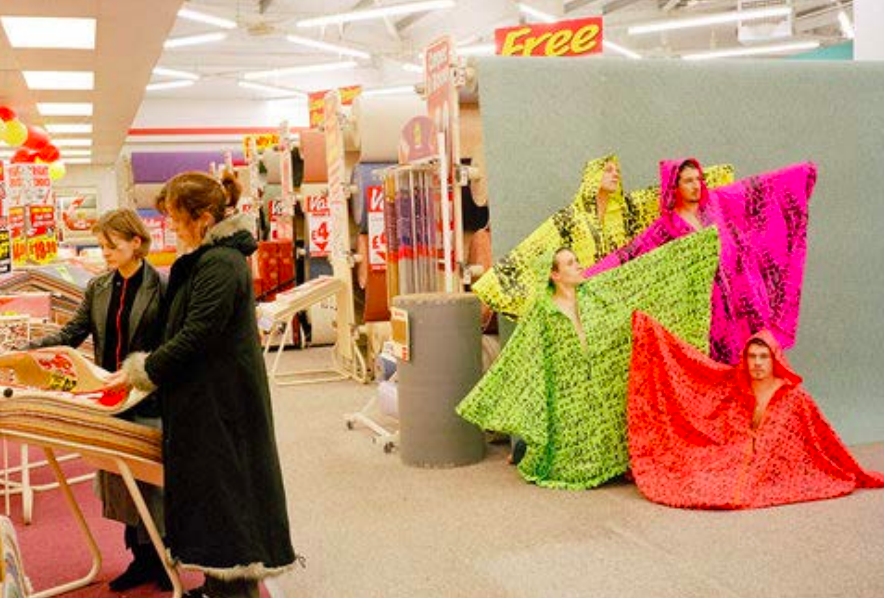
JASON EVANS – SMASH BABYLON MIND CONTROL , i-D, 2005
CONTRAST, ABSTRACT, FASHION, CULTURE, BRIGHT
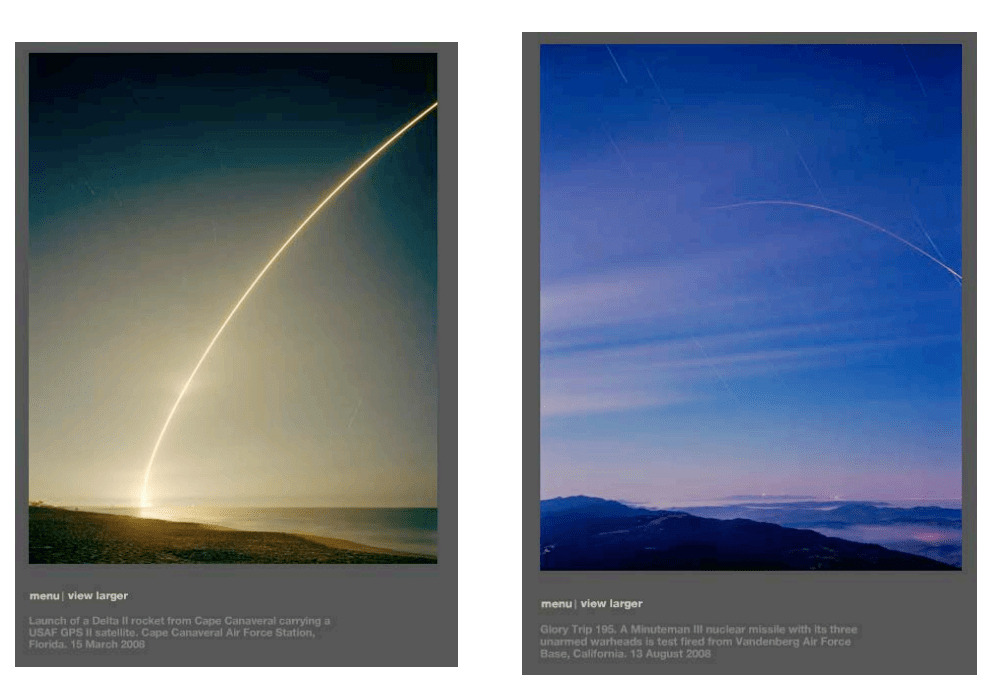
SIMON NORFOLK – FROM SERIES FULL SPECTRUM DOMINANCE: MISSILES, ROCKETS, SATELLITES IN AMERICA, 2008
NATURAL, SOFT, BEAUTIFUL, REALITY, DANGEROUS
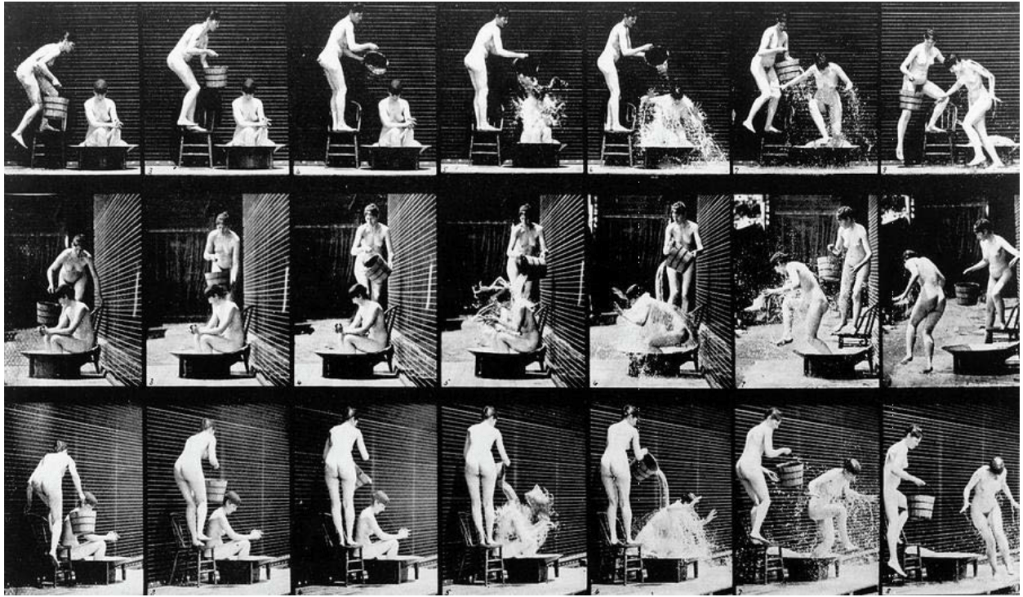
EDWEARD MUYBRIDGE
TIMELASPE, 180 DEGREES, PORNOGRAPHY?, REACTION
CHOSEN PHOTOGRAPH
Simon Norfolk has produced beautiful images, but they are not, because of the missile. Looking at these images the missile reminds me of shooting stars, especially with the dreamy coloured environment surrounding. At the time he took these images, it makes the sky and atmosphere look soft and calming for the audience. In reality, the ‘shooting star’ is a missile being launch. Simon has documented something as destructive, harmful, and dangerous look beautiful. He has made them look otherworldly like they are not supposed to be from this earth. It is an art piece of time.
The missile curve path, produces the leading line of the image, wondering where is this line leading to or is it going up in the sky further? As there is lots of negative space in this image, the line also breaks it up, giving the image more depth. The image itself is a juxtaposition, from the deadly missile and the peaceful environment surrounding it. I believe that Simon wanted to document this moment, showing what a missile can do to this beautiful earth, we live on, and why would we want to destroy it.
CHOSEN QUOTE
Steve Edwards:
“when we look at photographs we realise that the
image before us is tied to the thing it represents. Truth claims attached to
photographs largely turn on this recognition”
Photography: A Very Short Introduction, 84
Through
every photograph taken, there is always a reason or meaning behind it. I relate
to this quote because of the sense of representation. There are many ways to
represent a photograph, such as messages can be embedded through to the
audience, capturing reality, and genres etc. This representation behind the
image can help get the recognition of a photograph it needs, perhaps to convey
a powerful message. Thinking back on some of my work, I can see that I work
towards a meaning. Which helped shape the way I take photographs.

 SARAHLOCKYERUCA